


Replacing a Water Heater Magnesium Anode: When and How
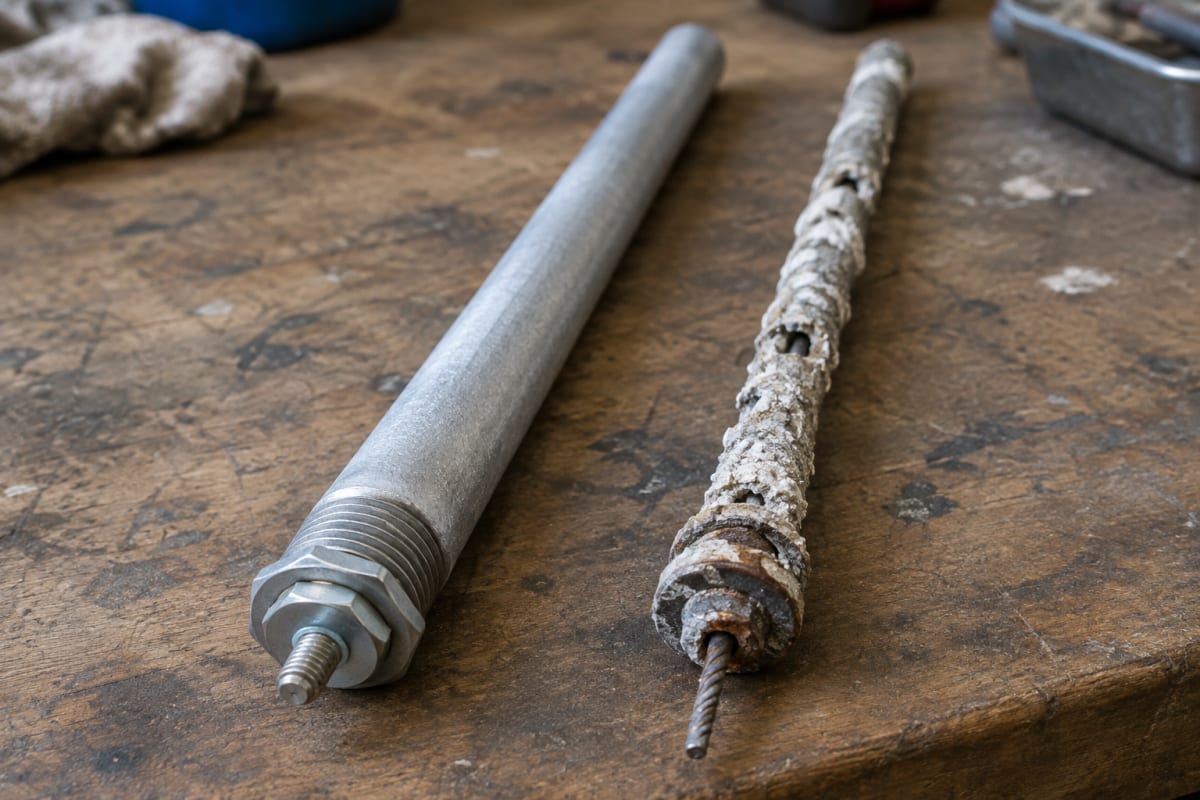
Did you know that an inexpensive metal rod is all that stands between your water heater's steel tank and catastrophic rust? Once the magnesium anode rod wears away, electrochemical corrosion turns directly on the tank itself—and once an inner tank begins to leak, it cannot be repaired. Here is everything you need to know about checking your anode and replacing it before damage occurs.
In brief: Inspect the anode every two years, or annually if your supply is hard or high in chlorides. Replace the rod when its diameter drops below 10 mm, more than half of the sacrificial metal has worn away, or the central steel core wire becomes visible. For many Ariston models, replacing the anode every two years is a mandatory condition of the manufacturer's warranty.
| Question | Answer |
|---|---|
| How often should it be inspected? | Every 2 years; annually with hard or chloride-rich water |
| When should it be replaced? | Diameter under 10 mm, over 50% worn away, or steel core visible |
| Where is the anode located? | Typically mounted on the heating element flange at the base or side of the cylinder |
| What else is needed? | A new flange gasket (the old seal must never be reused) |
| How long does the job take? | Service technicians estimate 30–60 minutes |
| What does it cost? | Spare parts from ~€14; professional replacement including parts approx. €35–€80 (some providers charge over €100) |
Why the Anode Wears Out and What Happens When It Fails
Most electric storage water heaters rely on an enamelled steel cylinder. Even under strict manufacturing controls, vitreous enamel inevitably contains microscopic fissures that leave bare steel exposed to water. The magnesium rod acts as a sacrificial anode: because magnesium is electrochemically more active than steel, galvanic corrosion consumes the anode first. The rod slowly dissolves over time, keeping the steel vessel fully protected.
Once the sacrificial magnesium is spent and only the bare core wire remains, galvanic protection stops completely. Corrosion immediately attacks the cylinder's inner walls, typically causing pinhole leaks around the welded base. Because this type of damage is irreparable, the entire appliance must be scrapped.
For this reason, manufacturers treat the anode as a consumable part excluded from warranty coverage, while making routine inspections a condition of the guarantee. For example, the Ariston BLU1 R water heaters supplied by Vipex carry a 5-year warranty on the inner tank and 2 years on other components, but explicitly exclude the sacrificial anode.
How Often Should You Replace a Magnesium Anode?
Manufacturer schedules are broadly consistent, though specific requirements vary:
- Ariston: Magnesium anodes must be replaced every two years to preserve the tank warranty. In areas with hard or chloride-rich water, Ariston advises annual inspections. Units fitted with stainless steel heating elements are an exception, as detailed in the Ariston VELIS EE user manual.
- Dražice: The estimated lifespan of an anode is two years, though actual wear depends entirely on water hardness and local chemistry. The state of the rod during the first inspection determines the long-term maintenance schedule.
- Atlantic: Atlantic units sold in Estonia stipulate servicing every two years—including inspecting and, if necessary, replacing the anode—as a binding warranty condition.
While two years is a sound baseline, local water chemistry often cuts this timeframe short.
Factors Affecting Anode Lifespan in Estonia
Water hardness. According to Tallinna Vesi, drinking water drawn from Lake Ülemiste reaches a hardness of up to 2.5 mmol/l during winter and spring, dropping to roughly 1.8 mmol/l in summer and autumn—classifying it as moderately hard to hard. In Tartu, municipal utility data reveals total hardness levels between 3.8 and 8.6 mg-eq/l. Field technicians in Tallinn and Northern Estonia regularly report sacrificial anodes eroding completely within just 12 to 24 months in these hard-water areas.
Chlorides. Ariston classifies water as aggressive when hardness drops below 80 ppm CaCO₃ (approx. 0.8 mmol/l) while chloride concentrations exceed 60 ppm, requiring annual inspections. Tallinna Vesi groundwater analyses have recorded chloride figures of 79 mg/l in Nõmme and 168 mg/l in Tiskre. Elevated chloride levels are also standard in coastal boreholes across the country. If your water comes from a coastal well, check the anode once a year.
Water softeners. Ion-exchange water softeners swap calcium and magnesium ions for sodium. While this prevents limescale, it raises electrical conductivity and speeds up anode consumption—an effect documented by manufacturers such as A. O. Smith and GE Appliances. If your property uses an ion-exchange softener, do not wait two years; inspect the rod after the first 12 months. Learn more about treatment setups in our guide to water filter types.
Hot water demand. Larger households draw higher volumes of fresh, oxygenated, mineral-bearing water into the cylinder, accelerating wear on the sacrificial rod.
Signs That an Anode Needs Replacing
The only definitive way to assess an anode is to pull it from the cylinder. Even so, several warning signs indicate that protection has broken down:
- Rusty or discoloured hot water, while cold tap water runs completely clear. As noted in Vipex's technical guidance, this usually means the anode is gone and the tank itself is corroding.
- A rotten egg smell affecting only the hot water. Magnesium can react with dissolved sulphates in well water to generate hydrogen sulphide gas.
- Moisture or pooling underneath the unit. If the cylinder is weeping, rust has breached the steel shell and the entire heater must be replaced. Read our advice on when to replace an old water heater.
Once you have removed the anode, replace it immediately if:
- The diameter has dropped below 10 mm. Several European manufacturers, including Atlantic, cite this as the absolute wear limit. A factory-fresh Ariston anode for 50–150-litre models measures 25.5 mm across.
- More than 50% of the original magnesium has dissolved, the threshold Ariston specifies for units run on aggressive water.
- The central steel core wire is visible, or the surface shows deep pitting, gouging, and uneven necking.
If the rod exhibits only light, uniform surface oxidation and retains a solid grey layer, you can refit it. Make a note of the thickness lost over the two-year period; this baseline will help you plan your next inspection. That said, if you have already pulled the flange apart and your warranty mandates a replacement, always fit a fresh rod.
Real-World Example: An 80-Litre Cylinder in Tallinn
Consider an Ariston BLU1 R 80 installed in autumn 2024. Under Ariston's terms, its mandatory two-year service falls in autumn 2026. A brand-new anode for this model starts at 25.5 mm in diameter. If the rod measures just 12 mm when removed, more than half of the sacrificial metal is already gone. This demonstrates that local water conditions are depleting the magnesium faster than standard intervals predict, meaning the following inspection should take place after 12 months rather than 24.
Selecting the Right Anode and Flange Gasket
Magnesium anodes are not universal components. Before ordering a replacement, check your user manual or measure the existing part against three critical parameters:
- Diameter (commonly 21.3 mm or 25.5 mm)
- Length (110 mm for compact units; 200 mm or more for standard capacities)
- Mounting thread size (Ariston models frequently feature a stepped M5/M8 combination thread to suit either stud size)
Using genuine parts ensures a proper fit and preserves warranty coverage. The Vipex catalogue of water heater spare parts includes genuine Ariston anodes:
- Magnesium anode 65103768-01 for Ariston 10–30 L models (21.3 mm diameter, 110 mm length, M5/M8 thread)
- Magnesium anode 993014-01 for Ariston SG, PRO R, and BLU/BLU1 R 50–150 L models (25.5 mm diameter, 230 mm length, M5/M8 thread)
Always order a matching flange gasket at the same time. Ariston advises replacing the seal whenever the flange is disturbed, while manufacturers like Metro Therm explicitly prohibit reusing old rubber gaskets. Compatible options at Vipex include the flange gasket 65150952-FA for Ariston VELIS EVO, VELIS PRO, and LYDOS PLUS 50–100 L models, as well as the flange gasket 65100282 for oval-flange SG and PRO R 10–30 L units. If the metal mounting plate has corroded, full assemblies like the flange with gasket 65103691 are available for SG, PRO R, and PRO PLUS 50–100 L water heaters.
Step-by-Step Replacement Guide
Below is the standard replacement procedure for European electric water heaters with a flange-mounted anode (such as Ariston or Dražice). Specifications vary between models, so consult your appliance manual before you begin.
- Isolate the electrical supply at the consumer unit or isolation switch, and test the terminals with a voltage tester to verify the power is completely off. Allow the stored water to cool to avoid scalding.
- Turn off the cold water supply valve feeding the cylinder.
- Open the nearest hot tap to vent pressure and draw air into the plumbing.
- Drain the cylinder fully via the drain cock or pressure relief valve into a floor drain or bucket. Flange-mounted elements require an entirely empty cylinder before disassembly.
- Unscrew the plastic lower cover and photograph all wiring connections before unhooking any spade connectors or terminals.
- Loosen the flange nuts or retaining bolts and ease the heating element assembly out of the cylinder (this holds the immersion element, thermostat pocket, and anode). Ariston cylinders feature either a standard 5-bolt flange or an oval/autoclave flange that must be pushed up into the tank, tilted, and turned sideways to withdraw.
- Unscrew the spent anode, brush off any loose limescale from the heating element and flange face, and screw the replacement rod firmly into position.
- Fit the new gasket and reseat the flange, tightening the bolts in a criss-cross pattern to ensure balanced pressure. Dražice, for instance, recommends a tightening torque of 22 Nm for its M8 flange bolts. Reconnect all wiring, double-checking the earth (ground) connection.
- Refill the water heater: leave the hot tap running, open the cold inlet, and wait until water flows steadily without spitting air.
- Check the flange seal thoroughly for drips before switching the power back on. Once the cylinder reaches operating temperature, inspect the base again and tighten the bolts marginally if any moisture appears.
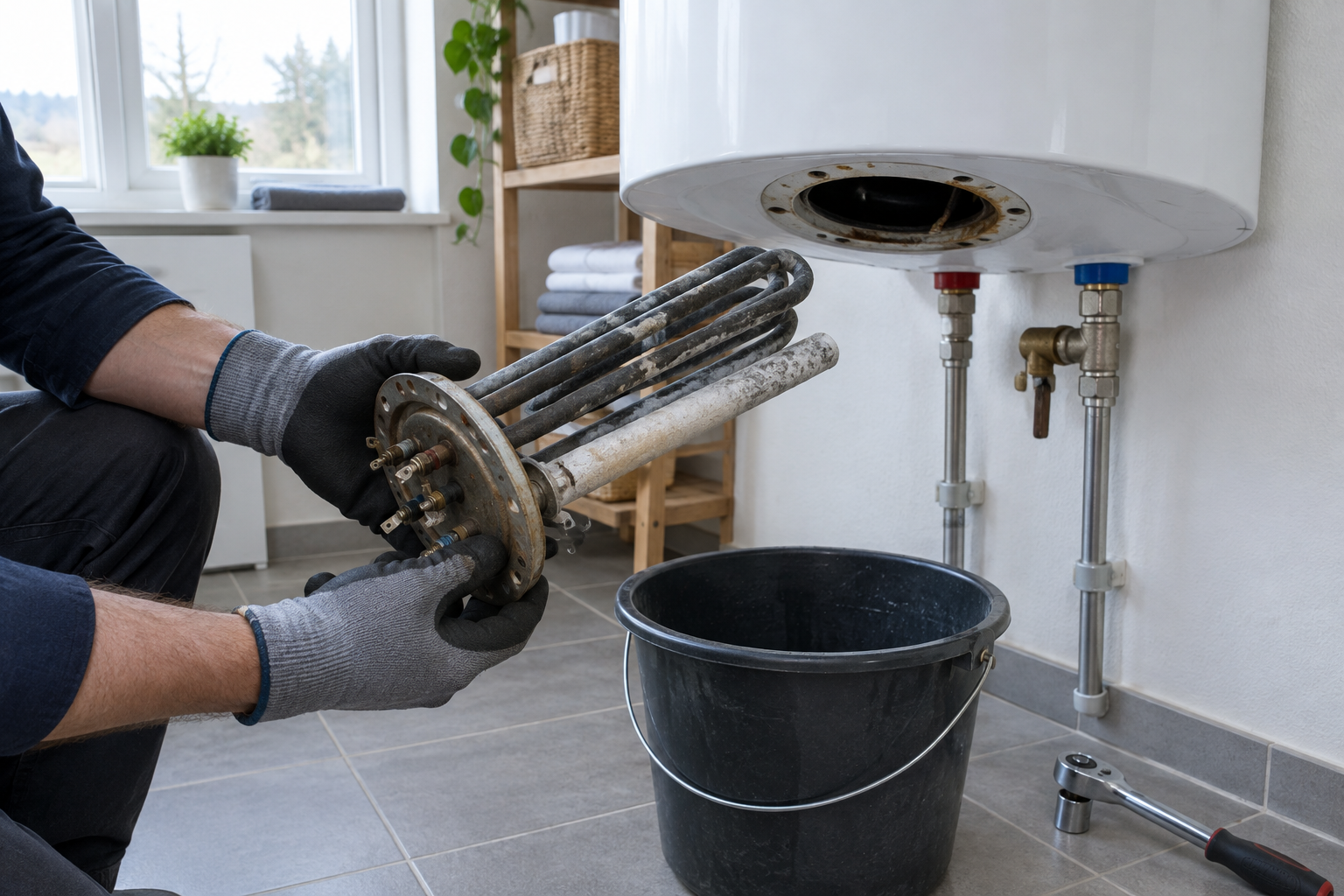
Because this job requires pulling the heating element, it is the ideal time to descale the element sheath. Ariston recommends descaling the element every two years. For step-by-step guidance on removing limescale, see our water heater maintenance and cleaning guide.
Common Mistakes to Avoid
- Dry firing the element. Electric immersion elements must be fully submerged before receiving power. Turning the power on while the cylinder is empty or partially filled will destroy the element within seconds.
- Reusing the old gasket. Heat-set rubber hardens over time. Reusing a flattened gasket almost always leads to a slow leak within days of reassembly.
- Torquing bolts in circular order. Tightening nuts clockwise around the flange warps the plate and pinches the gasket. Work diagonally across the flange in alternating stages.
- Overlooking the earth lead. Dražice specifically highlights the protective earth bonding; a loose or forgotten earth wire creates a severe shock risk.
- Discarding the anode without fitting a replacement. Some homeowners remove a worn anode to cure sulphurous water odours. Manufacturers like Rheem and A. O. Smith point out that operating an unshielded steel tank immediately voids the warranty and can cause leaks within a year.
DIY vs Professional Servicing
Mechanically, replacing an anode is a basic job, but it involves both pressurised plumbing and mains electrical connections. Most major manufacturers—including Tesy, Metro Therm, and Dražice—advise using a qualified service technician. If you are not entirely comfortable isolating circuits or working with electrical wiring, call in a professional.
In Estonia, professional call-out rates for anode replacement start around €35, with typical jobs running between €40 and €80 including parts and labour (though some Tallinn specialists charge €100 or more). Considering that replacing a failed 80-litre unit such as the Ariston VELIS PRO 80 costs upwards of €500 at Vipex, routine servicing is well worth the investment.
If your appliance is under warranty, keep two essential rules in mind: retain all parts receipts and technician job sheets as proof of maintenance, and always use OEM-spec components. Check with your supplier beforehand to ensure DIY servicing does not invalidate your warranty terms.
Titanium Anodes and Low-Maintenance Alternatives
A popular alternative to traditional sacrificial rods is an impressed-current titanium anode. Driven by an external low-voltage plug-in transformer, titanium rods do not erode or shed material. Dražice describes its titanium system as a fit-and-forget solution for enamelled vessels up to 800 litres. The only catch is that the control module requires uninterrupted mains power—meaning it cannot run through an off-peak night-rate timer.
A powered titanium anode is especially useful if:
- Your hot water carries a persistent rotten egg smell that flushing, replacing magnesium rods, and boosting temperatures above 60 °C cannot cure (a diagnostic tip supported by Galmet).
- Aggressive well water consumes standard magnesium rods every 12 months.
- The cylinder is installed in a restricted space or cupboard where removing the heating flange is difficult.
Before buying, verify that the powered anode is compatible with your model and that an unswitched mains socket is available nearby.
If you are shopping for a new appliance, another practical low-maintenance solution is a unit with a dry heating element. In models like the Atlantic Steatite range, the ceramic element is sealed inside an enamelled steel pocket, keeping it completely out of contact with water and slashing scale accumulation. Remember, however, that these cylinders still rely on a magnesium rod to guard the steel vessel, so regular anode checks remain essential. See our guide on 5 common mistakes when choosing a water heater for further advice.
The sacrificial anode is the least expensive component inside your water heater, yet it alone dictates whether the cylinder lasts its full 10 to 15 years. Check your appliance's service history: if it has been more than two years since the anode was last inspected, pick up the correct replacement anode and flange gasket from the Vipex range of water heater spare parts. If your cylinder is already weeping, explore our full range of new water heaters to find a high-efficiency replacement.