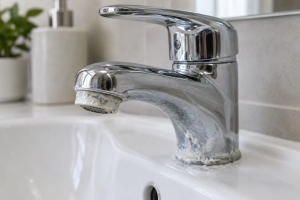



Removing Limescale from Faucets: Citric Acid and 10 Minutes
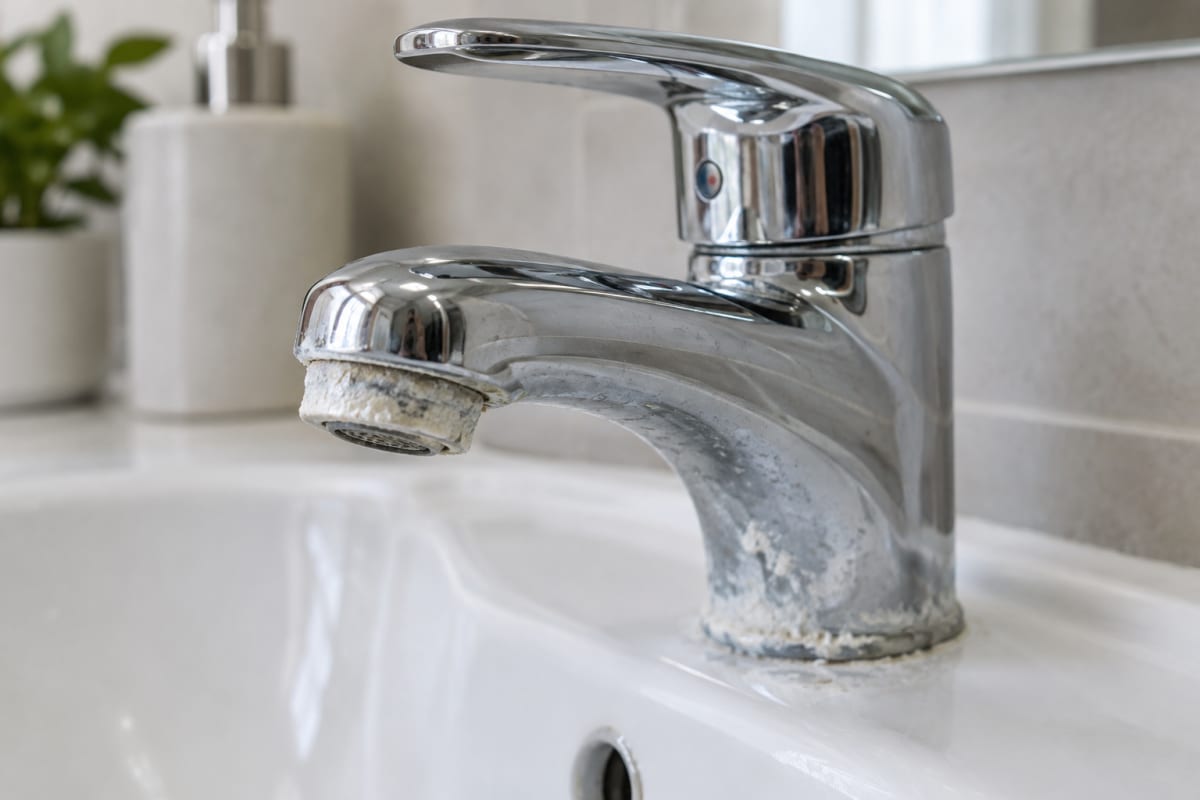
If you have a chalky white crust around your spout and water spraying haphazardly in all directions, limescale is to blame. Fortunately, removing it without ruining your chrome or matte black finish is straightforward—provided you pick the right acid, keep contact time short, and disassemble the aerator.
The short version: Clean faucet surfaces using a soft cloth and a citric acid-based cleaner. Always apply the product directly to your cloth rather than spraying it onto the fixture, let it work for no more than 10 minutes, and rinse thoroughly with clean water. Soak aerators and shower heads separately in a citric acid solution. Avoid vinegar, hydrochloric acid, and scouring pads entirely—major manufacturers explicitly prohibit them in their care instructions.
| Area / Component | What to Use | Contact Time | What to Avoid |
|---|---|---|---|
| Chrome body | Citric acid-based cleaner on a cloth, or warm soapy water | Up to 10 min | Vinegar, hydrochloric acid, scouring pads |
| Matte black, colored, or PVD finishes | Citric acid-based cleaner applied with a cloth | Up to 10 min | Microfiber cloths, stiff brushes, abrasive cleaners |
| Aerator | Soak in warm water mixed with a citric acid cleaner | A few minutes | Scrubbing with wire brushes |
| Shower head | Soak the spray face in a citric acid solution | Up to 10 min | Submerging push-button mechanisms entirely |
Why Limescale Accumulates So Fast on Estonian Faucets
Limescale consists mainly of calcium carbonate, which settles onto faucet bodies and inside aerator screens as hard water evaporates. Water hardness comes from dissolved calcium and magnesium salts. As the water utility Tallinna Vesi notes, hard water is completely safe to drink, but it accelerates limescale accumulation significantly.
Hardness levels throughout Estonia run notably high:
- Tallinn: Tallinna Vesi reports that drinking water leaving its treatment plant measures up to 2.5 mmol/l in winter and spring, and from 1.8 mmol/l in summer and autumn. On the utility's scale, 2–3 mmol/l is classified as hard.
- Tartu: According to Tartu Veevärk, the total hardness of municipal tap water ranges between 1.7 and 4.5 mmol/l. A 2021 ERR report noted that tap water in the northern part of the city can be twice as hard as in other neighborhoods.
- Rural areas and private wells: A UNECE report indicates that roughly 65% of Estonia's population relies on groundwater. Water pumped from private boreholes up to 200 meters deep is predominantly calcium-magnesium-bicarbonate water, making heavy limescale virtually unavoidable.
Acids dissolve limescale through a chemical reaction: calcium carbonate reacts with citric or acetic acid to produce water-soluble salts, water, and carbon dioxide—the source of that telltale fizzing. Warm solutions react faster because molecules move more quickly and collide more often. However, that same chemical action will attack your faucet's decorative plating if the acid is left on too long or used at excessive concentrations.
Which Cleaners Are Safe for Faucet Finishes?
A faucet's finish dictates which cleaning products you can safely use. Leading manufacturers enforce surprisingly strict guidelines:
- Hansgrohe specifies mild, citric acid-based cleaners. Products containing hydrochloric acid, formic acid, acetic acid, or chlorine bleach are strictly prohibited. Contact time must not exceed 10 minutes, followed immediately by a thorough rinse with clean water. These rules apply equally to standard chrome and colored finishes.
- GROHE advises against all aggressive acids, commercial descalers, household vinegar, and acetic acid-based cleaners, as they permanently dull the surface. For routine care, the brand recommends nothing more than a damp cloth with mild soap, followed by a rinse and towel dry.
- Mechanical scrubbing: Both brands strictly forbid scouring powders and abrasive pads. Hansgrohe also cautions against brushes and microfiber cloths, recommending standard soft sponges or cotton cloths instead.
Household vinegar is often touted online as a go-to remedy, yet both GROHE and Hansgrohe explicitly warn against using it. Unless your fixture's manual specifically permits it, stick to citric acid.
PVD finishes (Physical Vapor Deposition) offer superior scratch resistance and require no special treatments, according to Hansgrohe. Even so, the manufacturer advises the same gentle routine: citric acid cleaner applied on a soft cloth, avoiding abrasive pads and microfiber.
Safety warning: Never mix acidic cleaners (such as citric acid, vinegar, or toilet bowl cleaners) with chlorine bleach. As Poison Control warns, combining acids with bleach produces toxic chlorine gas, which damages the respiratory tract, eyes, nose, and throat. Hansgrohe also prohibits mixing different cleaning agents under any circumstances.
Vipex's guide to caring for sinks and faucets reinforces this advice: never use harsh chemical descalers on chrome, as they will strip and permanently ruin the finish.
Step-by-Step: How to Descale a Faucet
- Check the user manual. If your fixture came with brand-specific care guidelines, follow them to protect your warranty coverage.
- Wipe off loose grime. Use warm water, a drop of mild dish soap, and a soft cloth. For light, fresh mineral film, this is often all you need.
- Apply the cleaner to a cloth. Spray your citric acid cleaner onto a cloth or sponge—never directly onto the faucet. This keeps acidic mist from working its way under handles or degrading internal seals.
- Let it sit for up to 10 minutes. For stubborn deposits around the base of the fixture, wrap a cleaner-dampened cloth around the metal. Watch the clock: 10 minutes is the upper limit recommended by Hansgrohe.
- Rinse thoroughly with fresh water. Any leftover acid will continue attacking the finish long after the limescale has dissolved.
- Buff dry with a soft cotton towel. Leaving the surface wet will immediately create fresh mineral spots.
- Repeat if necessary. For thick deposits, two short applications are far safer than a single prolonged soak.
If a finish has already developed dull, pitted patches or started peeling, no cleaner will restore it. That type of damage almost always stems from past use of aggressive chemicals or abrasive scouring pads.
How to Remove and Clean an Aerator
When your water stream turns weak, uneven, or begins spraying sideways, a clogged aerator is usually the reason. The aerator is a small insert packed with fine mesh screens threaded into the spout tip to mix air into the flow. To learn more about how it works, see our guide on what a faucet aerator is and how it saves water.
How to remove an aerator:
- Shut off the tap and place a washcloth over the sink drain so small parts cannot slip down the pipe.
- Standard external aerators unscrew counterclockwise. Try loosening it by hand first. If you need pliers, wrap masking tape or a cloth around the housing to protect the finish.
- Concealed (cache) aerators require a dedicated service key, usually included in the box with the faucet. Common European thread sizes include M24x1 (male thread) and M22x1 (female thread). Neoperl produces service keys for M22, M24, and M28 housings, shaped to engage the recessed notches.
- Take note of the assembly order—washer, mesh screens, and outer housing—or snap a quick photo on your phone before taking it apart.
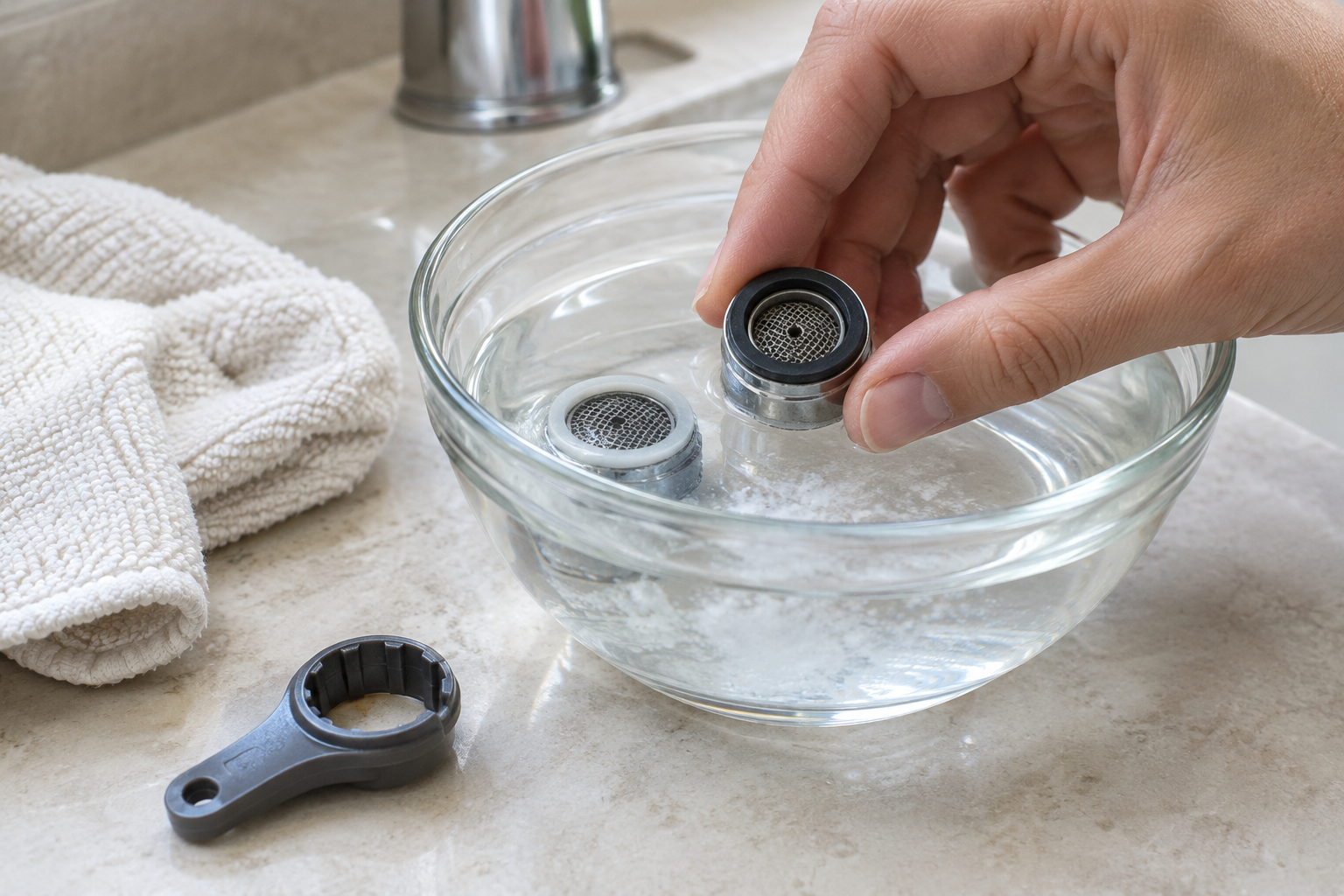
Cleaning: Per Hansgrohe's care instructions, place the dismantled aerator in a small bowl of warm water mixed with a mild citric acid cleaner and soak it for a few minutes. Rinse thoroughly under running water, gently wiping away any remaining scale with your fingertips or a soft toothbrush. Repeat the soak for heavy encrustations.
Some faucets feature aerators with flexible silicone nozzles that shed scale when rubbed with a thumb. For instance, the Deante Lima kitchen mixer in Vipex's catalog includes an M22 silicone aerator; on models like this, a weekly wipe of the nozzle face is all the maintenance you need.
When to replace: If the mesh screen is crushed, the plastic insert has cracked, or the scale simply will not dissolve, replacement is faster and cheaper than scrubbing. In Vipex's selection of aerators, replacement 22 mm and 28 mm models for Harma fixtures start at just €1.24. Double-check your thread size (M22, M24, etc.) and whether you need male or female threading before buying—or bring the old aerator with you to the store.
Descaling Shower Heads and Hand Showers
Shower heads clog quickly because droplets evaporate on the tiny nozzles after every use. Hansgrohe recommends this process:
- Unscrew the hand shower from its hose and pop out the small mesh screen nestled inside the inlet coupling.
- Set the shower head in a shallow dish so only the spray face sits in a mild citric acid solution, and soak it for no more than 10 minutes.
- If your hand shower has a push-button spray selector (such as a Select button), keep the button mechanism out of the descaling liquid.
- Rinse the shower head thoroughly inside and out with clean water.
- If the nozzles are silicone or rubber, massage away mineral buildup with your fingers before soaking.
For fixed rain shower heads that cannot be removed from the arm, fill a small plastic bag with diluted citric acid solution and secure it around the spray face using a rubber band. You can use the same method on a stuck faucet aerator. Keep to the 10-minute limit and ensure liquid does not run down the plated supply pipe.
If the nozzles remain clogged or the spray pattern is permanently distorted, replacing the unit is often the most practical route. Vipex's range of shower heads includes easy-clean models with silicone nozzles designed specifically to resist scale.
Stiff Lever Handles and Leaking Faucets
Surface scale is only half the battle. Hard water also builds up inside the mixer body itself:
- Single-lever mixers rely on ceramic cartridges. According to Vipex faucet guidelines, quality ceramic cartridges are rated for 300,000 to 500,000 operational cycles. If a lever feels stiff or starts squeaking, mineral deposits inside the cartridge housing are usually the cause. If the faucet drips when shut off completely, scale grit has likely scratched the ceramic discs.
- Thermostatic mixers use fine inlet filter screens on their thermostatic cartridges that easily clog with mineral scale, cutting water flow and causing temperature swings. Some manufacturers allow you to pull the cartridge out and soak it in descaling solution, while others treat it as a sealed unit that must be replaced.
To service or replace a cartridge, shut off the water supply, pry off the decorative index button, back out the set screw, remove the handle and retaining nut, and lift the cartridge free. If you are not comfortable tackling plumbing repairs, hire a licensed professional—improper seating or over-tightening the retaining collar can cause leaks and costly water damage. You can find replacement cartridges and gaskets in Vipex's catalog of faucet spare parts; verify your fixture's exact model number before purchasing.
If flow remains weak after cleaning the aerator, or if the unit still drips after a cartridge swap, read our guide on when to replace a shower mixer.
Common Descaling Mistakes to Avoid
- Soaking the entire faucet in vinegar. Tying a bag of vinegar over a faucet and leaving it overnight is a common DIY mistake. Extended acid contact strips chrome plating and degrades internal rubber O-rings and plastic parts.
- Spraying cleaner directly onto the fixture. Spray mist penetrates under the handle and past seals, settling into crevices where it cannot be rinsed out. Always spray the cloth first.
- Using scouring pads or steel wool. Abrasive pads leave microscopic scratches on chrome and PVD coatings, creating an even rougher surface for future limescale to grip.
- Skipping the rinse. Chemical residue left behind will continue eating into the finish long after the scale is gone.
- Mixing chemicals. Combining acid descalers with chlorine bleach creates hazardous chlorine gas.
Preserving your warranty is another reason to be careful. While Vipex faucets carry a 5-year warranty, many sanitaryware brands (such as Blue Star) state in their warranty conditions that cartridge failures resulting from water impurities or limescale are excluded from coverage. Damage to surface finishes caused by unapproved chemicals is likewise classified as user error.
How to Prevent Limescale Buildup
- Dry the fixture after use. As GROHE emphasizes, a quick daily wipe with a dry cloth keeps standing droplets from drying into stubborn mineral crusts.
- Clean the aerator on a regular schedule. In areas with hard water, such as Tartu or homes on private wells, periodic cleaning maintains steady water pressure and prevents backpressure on internal seals.
- Select finishes that hide mineral spots. As covered on the Vipex blog, brushed finishes camouflage water marks and fingerprints far better than mirror-polished chrome. Find more design tips in our guide to bathroom planning for hard-water homes.
- Install a water softener or whole-house filter. If you are scrubbing fixtures every weekend, treating your water at the point of entry is often cheaper over the long run than continually replacing cartridges and aerators. Compare your options in our water filter guide.
The same gentle citric acid routine works equally well elsewhere in the bathroom. For glass surrounds, see our guide on how to clean shower enclosure glass.
Keeping your fixtures looking pristine comes down to three basic rules: use citric acid, never exceed 10 minutes of contact time, and always rinse and dry thoroughly. If your faucet has already lost its finish or continues to drip despite fresh parts, browse Vipex's faucet collection or visit our showroom at Kriidi 10 in Tallinn, where our team can help you select the most durable finish for your local water supply.