


How to Choose a Showerhead: Flow Rate, Size, and Material
That luxurious rain showerhead in the showroom can easily turn into a disappointing drizzle once fitted at home. More often than not, the showerhead itself is not at fault. In most cases, the real culprit is a mismatch between the fixture's flow rate, your home's water pressure, and the existing plumbing. Before you buy, here are the essential specifications you need to check.
At a glance: Select a showerhead that matches your plumbing system’s actual water supply and pressure, rather than relying on aesthetics alone. A water-saving hand shower typically draws 6–9 l/min, whereas a generous rain showerhead demands 8–15 l/min. Before purchasing, run a simple bucket test to measure your existing flow rate, verify the manufacturer's minimum operating pressure (typically between 0.5 and 1.5 bar), and make sure your fittings use standard G 1/2 threads. If you live in a hard-water area such as Tallinn or Tartu, look for rub-clean silicone nozzles.
| Your Setup | Recommended Fixture | Why |
|---|---|---|
| Compact enclosure (80×80 cm) | 200 mm overhead shower or a hand shower on a slide rail | An oversized head will spray directly onto the glass panels, soaking you the moment you open the door. |
| Spacious walk-in shower | 250–300 mm rain showerhead + secondary hand shower | The overhead plate delivers broad, immersive coverage, while the hand shower provides targeted rinsing and simplifies cleaning. |
| Instantaneous (tankless) or small storage water heater | Showerhead rated up to 8 l/min | Every extra litre of water per minute places heavy demands on your heating capacity. |
| Low water pressure (private well, top-floor flat) | Low-pressure model or an air-injected (aerated) showerhead | Large rain showerheads need adequate pressure to generate an even, satisfying cascade. |
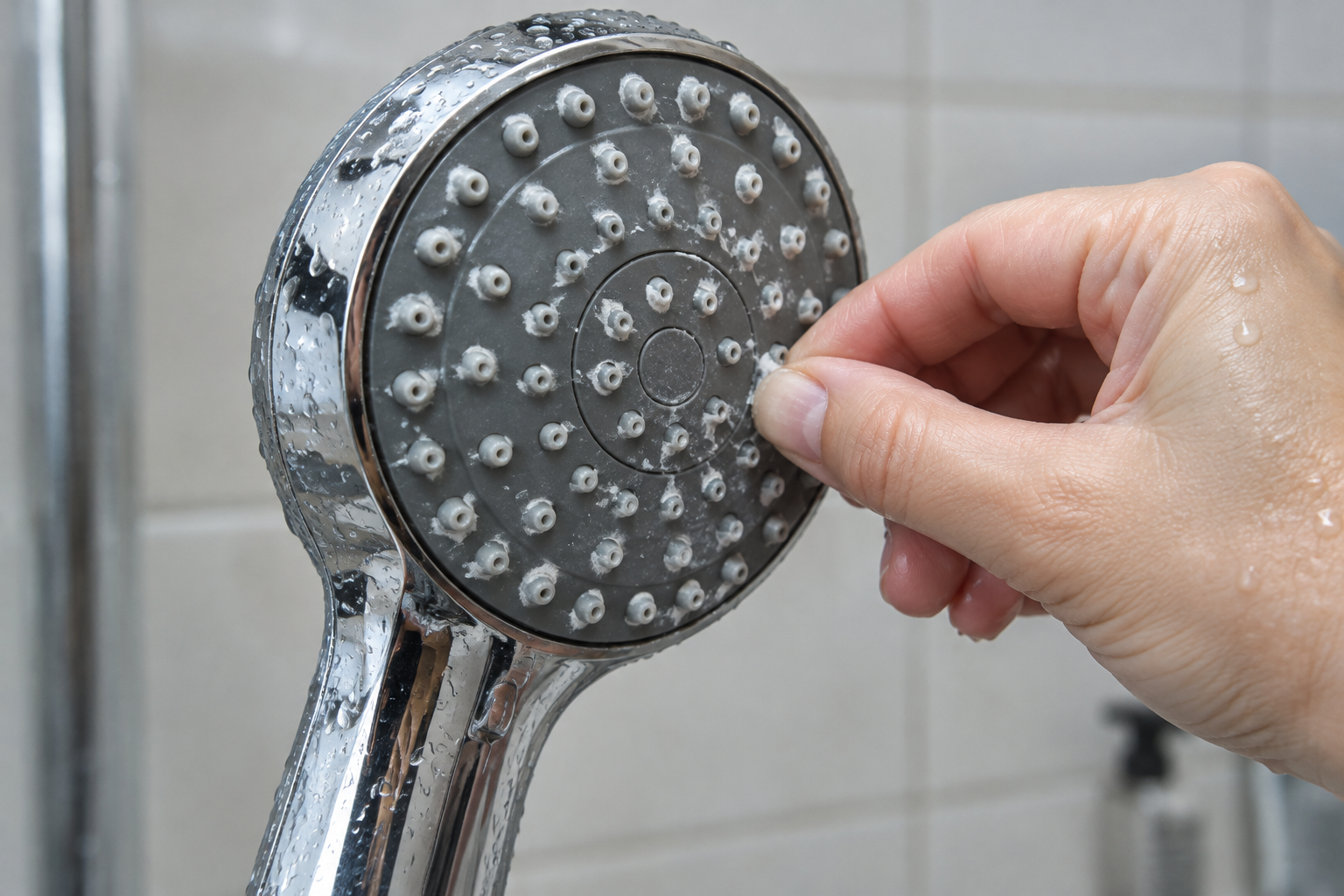
| Hard water supply | Silicone nozzles with an easily accessible spray plate | Limescale deposits can be wiped off flexible silicone nubs with a quick rub of your thumb. |
Overhead Shower, Hand Shower, or Complete System: Which Do You Need?
Showerheads fall into three core categories, and most contemporary bathrooms combine at least two.
Hand showers offer maximum versatility. They let you rinse off without wetting your hair, make washing children or pets straightforward, and allow you to hose down the shower enclosure during cleaning. Many hand showers also incorporate multiple spray modes, such as concentrated massage or gentle aerated streams. If your bathroom currently has a basic exposed mixer, replacing the hand shower is the fastest and most affordable upgrade you can make.
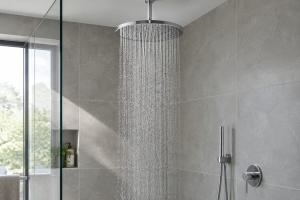
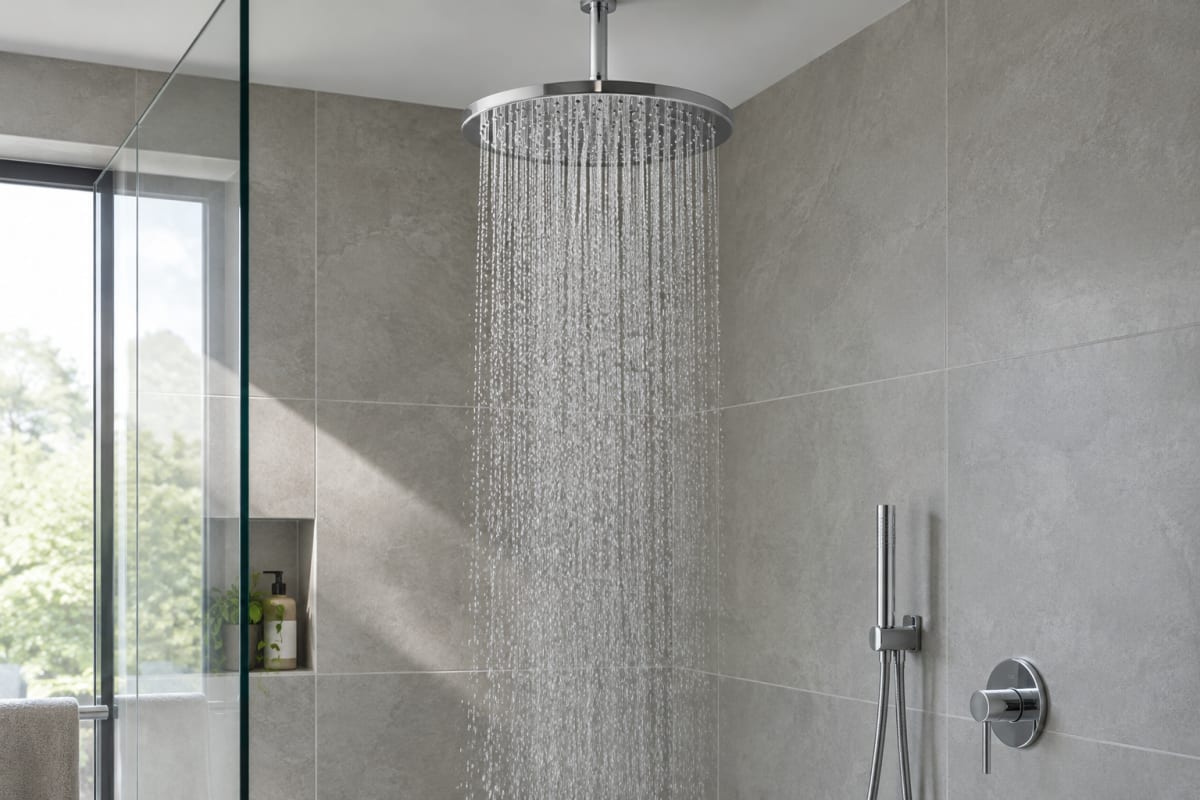
Overhead showers (rain showers) are fixed directly to the ceiling or extended from a wall arm. Their broad spray faces distribute water evenly across the shoulders, recreating the feel of a gentle downpour. Vipex carries overhead models in both round and square formats across various dimensions, including the Deante Floks 300 mm overhead shower and the slimmer Ramon Soler Ultraslim 240 mm.
Exposed shower systems and sets bundle the mixer, overhead head, hand shower, and diverter into a single coordinated unit. When remodeling a bathroom or swapping out an old mixer valve, an all-in-one shower system is usually the simplest path forward, ensuring all fittings align mechanically and visually. A prime example is the Ramon Soler Blautherm 945401RP300, a telescopic thermostatic shower system featuring an integrated diverter, an adjustable rail, and a Ø300 mm ABS overhead shower.
Flow Rate and Water Pressure: The Real Drivers of Performance
A showerhead's flow rate indicates how many litres of water pass through it each minute. According to the German Blue Angel (Blauer Engel) environmental standard, a conventional showerhead uses roughly 15 l/min, whereas an eco-conscious model caps consumption at 9 l/min or less across typical domestic pressures—a reduction of at least 40%.
Under the European sanitaryware sector's voluntary Unified Water Label, flow rates fall into five performance bands:
- Class 1: Up to 6.0 l/min
- Class 2: Up to 8.0 l/min
- Class 3: Up to 10.0 l/min
- Class 4: Up to 13.0 l/min
- Class 5: Over 13.0 l/min
The Vipex catalogue includes efficient models such as the Bubble-Stream Coronado water-saving hand shower, rated at 6.5 l/min, alongside the Bubble-Stream Falster at 10 l/min. Both use standard 1/2-inch connections.
The Real Cost of Flow Rate
To see the financial difference, take a standard 10-minute shower that heats water from 10 °C to 40 °C:
- 12 l/min showerhead: Uses 120 litres of water and requires approximately 4.19 kWh of energy to heat.
- 8 l/min showerhead: Uses 80 litres of water and requires approximately 2.79 kWh of energy to heat.
For one person showering once a day, stepping down to 8 l/min saves roughly 1.4 kWh daily—around 510 kWh per year—over and above the savings on your municipal water and wastewater bills. Keep in mind that these numbers represent pure thermodynamic heating energy; standing losses from hot water cylinders will push real-world energy use higher.
Flow rates matter even more when using an instantaneous (tankless) electric water heater. Heating 8 litres of water per minute from 10 °C to 40 °C demands around 17 kW of raw heating capacity before accounting for efficiency losses. If you pair an undersized instantaneous unit with a high-flow rain shower, the heater will be overwhelmed, causing the water temperature to plunge. To learn more, read our guide to tankless vs storage water heaters.
Minimum Water Pressure: Check the Specs
There is no universal minimum operating pressure for rain showers; requirements vary widely by design and brand. For example, Roca shower systems are generally rated for 1 to 5 bar, Hansgrohe's Crometta E 240 specifies at least 1 bar, and several large-format overhead plates require a minimum of 1.5 bar to spray evenly. Conversely, purpose-built low-pressure heads can run smoothly at just 0.5 bar.
Checking operating thresholds is especially critical if you live on the upper floors of an older apartment block, rely on a private well and pressure vessel, or have pipework narrowed by decades of internal scale.
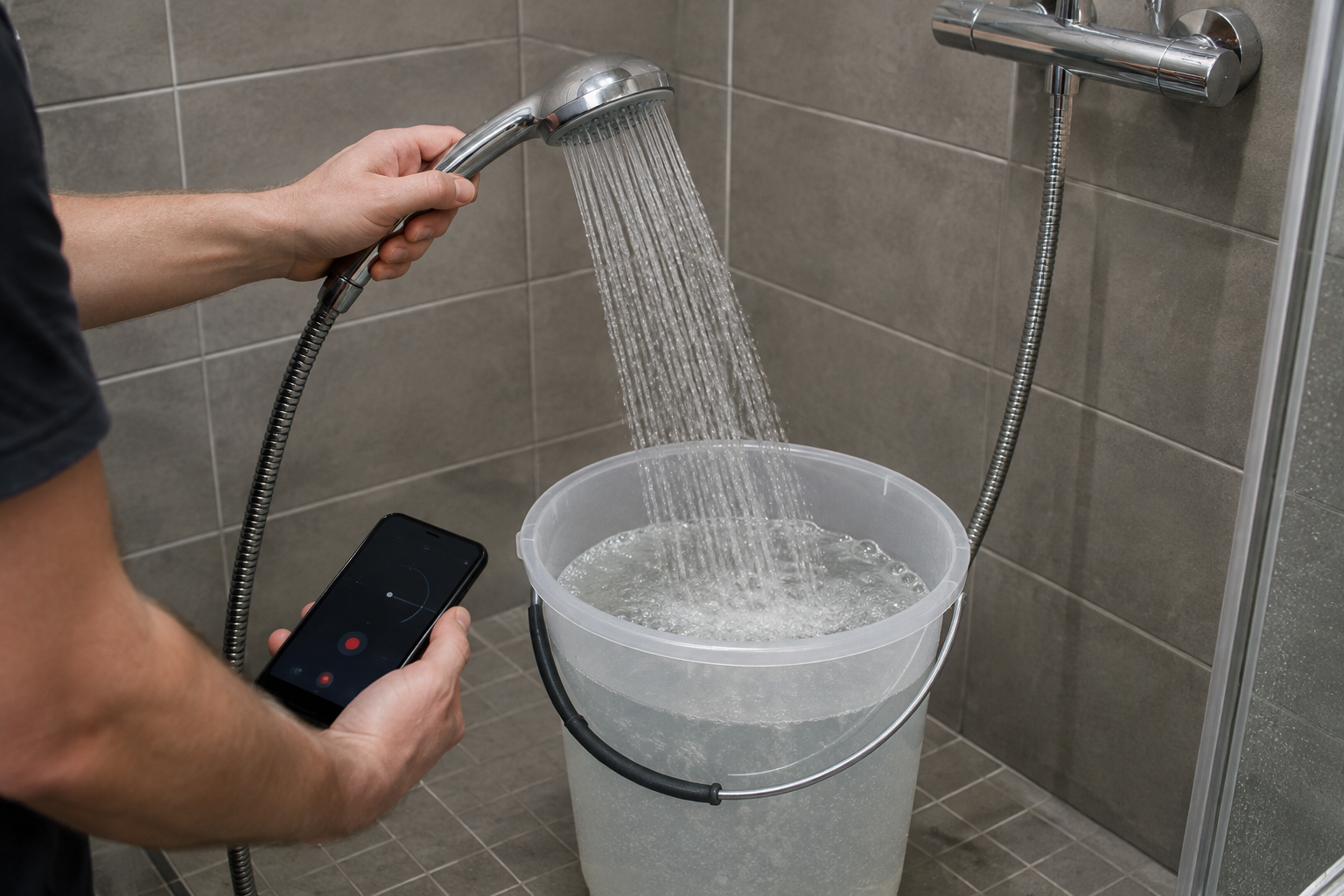
The 10-Minute Bucket Test
You can measure your actual domestic flow rate in moments using household items:
- Grab a bucket of known volume (a 10-litre bucket works best).
- Open the shower valve fully and start a timer.
- Stop timing the precise moment water hits the target mark.
- Divide the volume by the elapsed seconds, then multiply by 60. For instance, if a 10-litre bucket fills in 60 seconds, your flow rate is 10 l/min; if it takes 100 seconds, your flow rate is 6 l/min.
Compare this measurement against the technical data sheet of your chosen showerhead. If your supply cannot deliver the volume a broad overhead model requires, the spray will droop limply rather than envelop you. When supply is limited, choose a smaller head, select an aerated low-pressure design, or have a plumber check your supply runs and pressure-reducing valves.
Sizing and Installation Height
Overhead rain showers are typically produced in 200 mm, 250 mm, and 300 mm diameters. While larger plates provide sweeping body coverage, they require substantially more water to fill: depending on internal channel design and nozzle count, an overhead plate consumes 8–15 l/min and needs consistent pressure between 1 and 2 bar to operate properly.
A quick sizing guide:
- 200 mm: Best for compact enclosures and homes with modest water pressure.
- 250 mm: An ideal all-rounder for 90×90 cm enclosures and medium-sized shower areas.
- 300 mm: Reserved for spacious walk-in wet rooms supported by generous water flow and reliable pressure.
For wider layout considerations, consult our article on how to choose a shower enclosure based on bathroom size.
Mounting height is measured from the finished floor level or the standing surface inside the shower tray. Overhead showerheads should typically sit 200–210 cm above floor level, leaving 20–30 cm of clearance above the tallest person in the home. If anyone in your household is over 185 cm tall, mount the fixture higher. Where ceiling clearance is constrained, choose an angled wall arm or a telescopic riser rail with an adjustable bracket.
Fittings and Standards Compatibility
Across Europe, the dimensions, watertightness, mechanical strength, and acoustic qualities of showerheads and hand showers are defined by standard EN 1112 (ratified in Estonia as EVS-EN 1112:2008). Under this specification, hand showers connect using standard G 1/2 parallel threads. Flexible shower hoses are governed by the companion standard EN 1113.
In everyday terms, this means:
- Most residential hand showers and hoses are completely cross-compatible, using 1/2-inch female and male unions.
- Hoses are typically sold in 150 cm or 175 cm lengths. A 150–160 cm hose suits average-height users in standard enclosures or over-bath setups, while a 175–200 cm hose provides needed reach for taller users or low-mounted mixer taps.
- Showerheads integrated into all-in-one shower cabins often feature proprietary mountings. If you are replacing one of these units, source an authentic replacement from our shower cabin spare parts section.
- When planning a concealed (in-wall) installation, determine whether your overhead shower requires a horizontal wall-mounted arm or a vertical ceiling drop, ensuring the arm projection clears screens and door paths.
If your setup features a thermostatic mixer, it will pair seamlessly with water-saving showerheads, as thermostatic cartridges continuously balance incoming hot and cold supplies to maintain a steady temperature regardless of flow variations. Learn more in our guide to thermostatic shower mixers.
Materials and Surface Finishes
A showerhead’s construction dictates its weight, durability, and price. No single material is superior in every scenario; the key is choosing the right material for each specific component.
| Material | Weight | Best Suited For | Practical Considerations |
|---|---|---|---|
| Chrome-plated ABS plastic | Lightweight | Hand showers, lightweight overhead plates | Low-grade electroplating can blister or peel over time. |
| Solid brass | Heavy | Fixed overhead showers, wall arms, threaded elbows | Premium price point; places greater load on wall fixings. |
| Stainless steel | Medium | Ultra-slim overhead rain plates | Long-term corrosion resistance depends directly on steel grade (e.g., AISI 304). |
Lightweight ABS plastic is an ideal choice for hand showers because it reduces wrist fatigue and prevents cracked acrylic trays or chipped tiles if dropped. For fixed overhead showers, pay close attention to the inlet threads and swivel ball joint: plastic ball joints can crack if over-tightened, whereas solid brass or machined metal joints deliver years of dependable adjustment without leaking.
Your choice of finish also influences day-to-day upkeep. Dark, matte-black coatings highlight chalky white limescale far more quickly than bright chrome. Models like the Deante Cascada overhead shower are available in chrome, matte black, brushed gold, brushed steel, and titanium, allowing you to match your taps and hardware seamlessly. For cleaning advice, see our guide on bathroom fixtures for hard-water homes.
Dealing with Hard Water and Maintenance
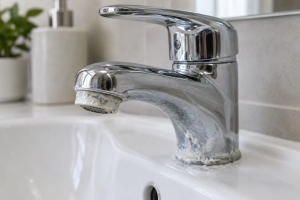
Mains tap water throughout Estonia is predominantly hard, making mineral scale the single biggest threat to shower performance. According to Tallinna Vesi, treated water leaving the plant exhibits hardness levels between 1.8 mmol/l in summer and autumn and 2.5 mmol/l in winter and spring (values between 2 and 3 mmol/l are classified as hard). Figures from Tartu Veevärk show hardness levels in Tartu ranging from 1.7 to 4.5 mmol/l. While completely safe to drink, hard water quickly precipitates inside narrow spray channels, cutting pressure and skewing spray patterns.
To prevent this, choose showerheads fitted with flexible rub-clean silicone nozzles. Rather than dissolving solid scale chemically, you can dislodge deposits simply by running a thumb over the flexible nubs while the water is running. The Harma Vision cabin hand shower, for instance, includes integrated anti-scale nozzles designed specifically for this purpose.
When your fixture requires a deep clean:
- Always review the manufacturer’s maintenance instructions first, as specialty finishes (such as PVD or matte black) have strict chemical limitations.
- Dissolve 1 to 2 tablespoons of food-grade citric acid into one litre of lukewarm water.
- Keep contact times short: while general household advice recommends 10–15 minutes, leading manufacturers like Hansgrohe advise soaking their fittings for no more than 5 minutes.
- Wipe the softened scale from the faceplate and thoroughly flush the showerhead with fresh water inside and out.
Citric acid is far safer for brassware and plating than household vinegar; acetic acid can attack thin chrome layers and degrade internal rubber O-rings. Hansgrohe explicitly warns against using cleaning agents containing hydrochloric acid, formic acid, active chlorine, or acetic acid. If you want to stop mineral buildup at the source, explore our guide to water filter types, which also covers dedicated inline shower filters.
Common Mistakes to Avoid
Matching an oversized rain showerhead with low mains pressure. Installing a 300 mm showerhead on a low-pressure line produces an underwhelming trickle around the outer rim. Always check your static pressure and run a bucket test before buying.
Overlooking your water heater’s true capacity. A 15 l/min overhead fixture will exhaust a standard hot water cylinder in minutes, while an undersized instantaneous water heater will struggle to maintain an acceptable temperature. If your heating capacity is constrained, choose a fixture rated at 8 l/min or lower.
Measuring mounting heights from an unfinished floor. Floor screed, underfloor heating, waterproofing membranes, tiles, and the depth of a shower tray can easily raise the finished floor level by several centimetres. Always calculate clearance from the finished standing surface.
Skipping the secondary hand shower. Relying solely on an overhead rain shower makes it awkward to clean enclosure glass or shower without washing your hair. Even if a broad rain shower is your primary choice, install a complementary hand shower via a diverter valve.
Replacing bespoke cabin showerheads with generic off-the-shelf units. Overhead fittings built into freestanding shower cabins or modular columns frequently rely on proprietary mounting flanges and hose elbows. Always check for genuine brand-specific components first.
Choosing the right showerhead starts with the realities of your domestic plumbing: establish your real-world flow rate, verify supply pressure and connection sizes, and then choose your preferred dimensions and finish. Explore the full Vipex range of showerheads and complete shower systems, or stop by our showroom at Kriidi 10, Tallinn, where our team will help you find the perfect shower setup for your bathroom.